
It’s late in the evening, and a Trip A Deal ad for China comes up on the TV screen. Next to me, Banjo, the Labrador retriever, is settled in for the night on his bed. I talk to him softly, as he closes his eyes. I stroke his white fur. It is important that I let him know he is safe. He is loved. It is only 24 hours later that I hear my mother singing to him.
I will admit, like many people, this story broke me. It left me feeling absolutely broken, and with no hope for humanity. Beautiful Wang Wang was full of love; she embodied everything good and whole about the world. You could see this in her eyes. You could see it in the way she looked after her puppies until the very end. But her fate was truly sealed when she came across five monsters dressed in a cloak of evil, who took pleasure in torturing her. Still, right up until her final breath, she was full of love. And those monsters can never take that away from her.
These monsters saw their actions as justified; to them, Wang Wang was nothing—merely an object. And according to their sick and twisted worldview, Wang Wang was an object to be played with. Well, I’m here to tell you that she wasn’t nothing. She was someone. Her life mattered.
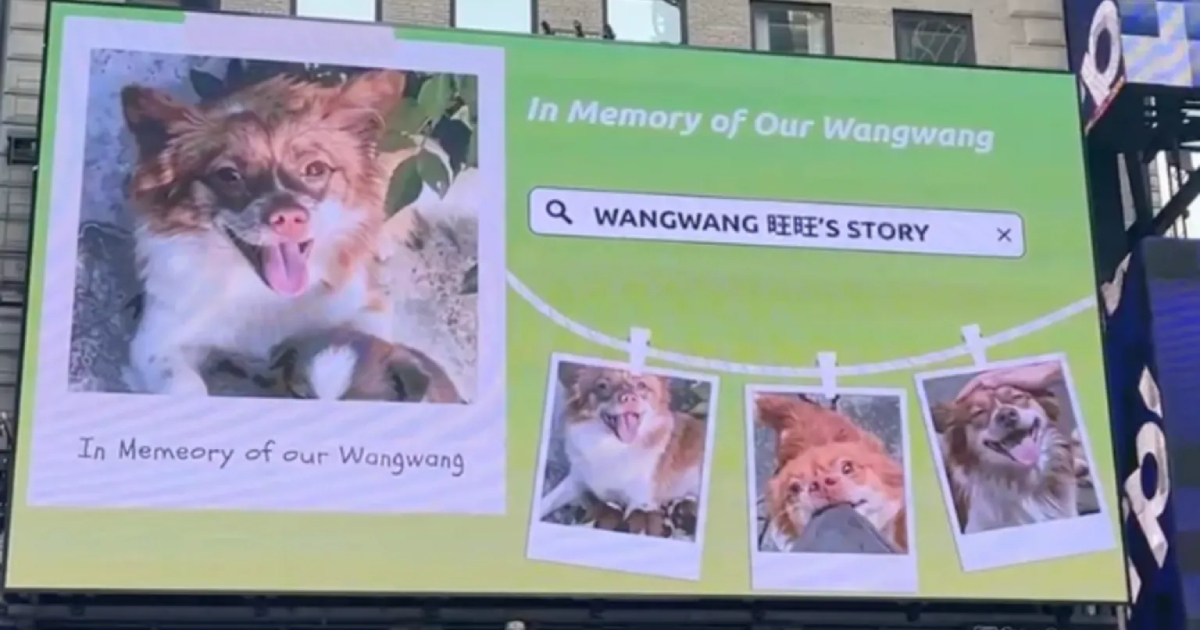
Wang Wang’s story of love deserves to be told. Her face is rightly on a billboard in Times Square for that very reason, as well as on billboards in places like Hong Kong and Tokyo. This case has drawn international attention and “united millions of people as they call on the Chinese government to introduce strong anti-cruelty legislation” (Species Unite). And united they have been. We have seen wave after wave of posts on social media, protests both in China and abroad, and online petitions. There have been many memorials, lighting up hundreds of screens across the globe.
The sad reality is that Wang Wang had to pay the ultimate price in a country that has no comprehensive animal welfare law. Animal cruelty is not “explicitly defined in Chinese legislation” (World Animal Protection). This means that nationwide, there are currently no laws prohibiting animal cruelty. China is indeed a poor performer in animal welfare, with an ‘E’ grade under the Animal Protection Index (API). A little bit of information on the API:
Countries are assessed under the API in a range of key areas, and are ultimately grouped into 4 goals:
- Recognition of animal sentience and prohibition of animal suffering
- Presence of animal welfare legislation
- Establishment of supportive government bodies
- Support for international animal welfare standards.
It is worth noting that Australia has a ‘D’ grade under the API, which remains very low compared to countries with strong animal welfare protections, such as Sweden and Austria. Australia actually has very poor animal welfare outcomes and is falling way behind other countries like the U.K., which has an overall ‘B’ grade. So while criticisms of China are more than welcome, we must remember that overall, Australia is still a very poor performer.
China does have some animal protections in place in certain areas, such as wildlife protection, regulations on the use of animals in research, and legislation governing farmed animals. However, these protections are fragmented and, as a whole, lack the core foundations of a comprehensive framework that recognises animal suffering.
At the local level, public pressure has led to some policy changes regarding responsible dog ownership. Examples include Beijing, where there is a draft regulation in place proposing a lifetime ban on dog ownership for those who severely harm and abuse them. In Chengdu, a new dog management regulation means that abandoning or abusing a dog may lead to heavy fines.
But legislation alone is not enough. To address any problem at its root always starts with education: “Without public understanding and support, legislation will be less effective” (Species Unite).
But when it comes to government accountability, China is really lacking. And we can see that in the way it censors the public. From a BBC article: “China’s Communist Party tightly controls media and the internet to suppress criticism of the state and to manage public anger.” As a result of this censorship, many social media platforms have been forced to remove posts about Wang Wang. Memorial advertisements have been ordered to be removed from public screens in some cities. Many others report that Chinese authorities have questioned and threatened their public activism. But as stated in another article, China’s censorship does indeed have limits. And that is why the fight has become so much more important worldwide.
You have the power to ensure Wang Wang’s tale lives on. Whether that be by displaying her face in public, continuing to share her story on social media, or talking about her in the animal rights space (because every animal matters). Or if you want to show that your actions matter in terms of what systems of exploitation we choose to support on an economic and political scale (you can make a difference at the individual level!), you could make a stand and choose to boycott well known Chinese companies, including Temu, Shein and, well…yes, Amazon, as most products on Amazon are indeed made and shipped from China. And every individual counts when it comes to pressuring countries to take responsibility for improving animal welfare.
I can hear the animal rights critics now. Why such a global outcry over one animal abuse case, when billions of farmed animals are suffering every second, every minute, every hour, and every day worldwide? (The cognitive dissonance is strong, they say). And non-vegans don’t bat an eyelid? It is true. As Henry Spira quotes in Eternal Treblinka, farm animals are “the most defenceless of all the world’s victims.” And what does the industrial farming system represent, if not an Eternal Treblinka? (I can hear the controversy now with the Animal Holocaust reference).
I do think that the horrible case of Wang Wang is instrumental in showing how public pressure can tip the scales in favour of creating a more just world for animals. And no country is exempt from criticism, Australia included.
At the end of the day, we should be speaking up for all animals. Farmed animals. Wild animals. Captive animals. Companion animals. They all matter. For what we see in each animal is a mirror. And that mirror is a reflection of our soul. Animals define who we are. They shape our humanity. So when we see and hear horrific acts of cruelty like what happened to Wang Wang, it is our duty to speak up and demand change to protect animals.
China, you must do better. And the public will not shut up until you take the matter seriously. May the global outcry continue. For Wang Wang. A dog that deserved all the love in the world in life. But in death, she unites us all with her story.